Stuart Rose: From M&S Trainee to British Retail Leader
The long retail career of Lord Stuart Rose covers Marks & Spencer, Arcadia, Argos, Booker, Ocado, Asda and board roles that remain active in 2026.

Introduction
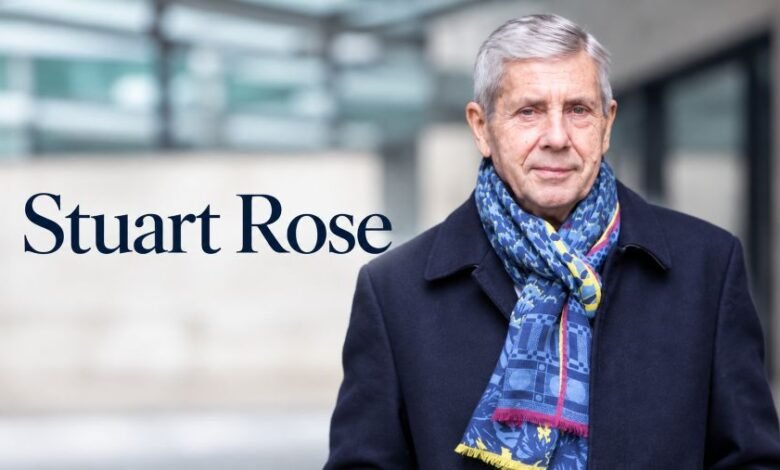
Stuart Rose is a British retail executive and life peer best known for leading Marks & Spencer during one of the most closely watched periods in the company’s history.
His story goes back much further. He first joined M&S as a management trainee in 1972. More than three decades later, he returned as chief executive, resisted a takeover approach from Philip Green and led changes across the retailer.
He later chaired companies including Ocado, Asda and EG Group. His work has also reached outside retail. He conducted an NHS leadership review for the UK government and has been a member of the House of Lords since receiving a life peerage in 2014.
As of September 2026, Rose remains active in business. The current House of Lords register records him as chairman of Zenith Automotive Holdings, a non-executive director of EG Group and Time Out Group, a director of Fulton Management Limited, and a consultant to Interpath Ltd.
Stuart Rose Quick Facts
| Fact | Verified detail |
|---|---|
| Full name | Stuart Alan Ransom Rose |
| Formal title | Baron Rose of Monewden |
| Date of birth | 17 March 1949 |
| Age in September 2026 | 77 |
| Birth area | Hampshire, England |
| Profession | Retail executive, company director and life peer |
| School | Bootham School, York |
| Known for | Marks & Spencer and senior UK retail roles |
| M&S career began | 1972 |
| Returned to M&S | 2004 |
| Life peerage | 2014 |
| Current main chairmanship | Zenith Automotive Holdings |
Rose’s date of birth is documented as 17 March 1949, while contemporary reporting says his parents settled in Hampshire and he was born there. His complete name and peerage title are confirmed by the official Crown Office notice creating him Baron Rose of Monewden, of Monewden in the County of Suffolk, in September 2014.
Early Life and Childhood
Stuart Rose did not spend all his childhood in Britain.
His father worked for the overseas civil service. When Rose was young, the family moved to what is now Tanzania. He attended school in Dar es Salaam before returning to England and attending Bootham School in York.
His family background was quite international too. Rose has publicly discussed Russian roots on his father’s side. His father’s family had fled Russia for China after the Russian Revolution, and their earlier surname was Bryantzeff. His mother’s family included Scottish and Greek ancestry.
He did not take the standard university-to-boardroom path.
Actually, his family had hoped he might study medicine. That did not happen. An early job came at the BBC, where he worked as an administrative assistant before securing a place on the Marks & Spencer management training scheme.
That decision set his career.
Starting at Marks & Spencer
Rose joined Marks & Spencer as a management trainee in 1972.
He stayed for around 17 years. During that first period he worked across different parts of the retailer and gained experience that later became important when he returned to run the company. The University of York’s 2026 career profile confirms the 1972 starting year and his departure in 1989.
Then he moved on.
And quite quickly, too.
Burton Group, Argos and Booker
After leaving M&S in 1989, Rose moved to the Burton Group, a major force in British fashion retail.
He later held senior leadership jobs at Argos and Booker. These were not quiet appointments. His time at Argos included dealing with Great Universal Stores’ takeover attempt, while his Booker period came during major changes in the food distribution business.
By this stage, Rose had become closely associated with businesses facing change, ownership questions or operating pressure.
The pattern would appear again.
Leading Arcadia Group
Rose became chief executive of Arcadia Group in 2000.
Arcadia controlled well-known high-street fashion names. Under Rose, the business went through major financial and operating changes before being sold to Philip Green in 2002.
The University of York’s 2026 profile specifically describes Rose as having turned around Arcadia before its sale.
Rose then spent a short period outside a full-time chief executive job.
M&S soon called again.
Stuart Rose and Marks & Spencer
Rose returned to Marks & Spencer as chief executive in 2004.
The timing mattered.
M&S was under pressure, and businessman Philip Green was pursuing a takeover of the retailer. Rose became the executive face of M&S’s defence. The takeover did not proceed, leaving the company independent.
Rose then focused on the retailer itself.
M&S worked on stores, products, clothing and food while trying to rebuild sales and customer confidence. His period at the top became the part of his career most closely associated with his public name.
In 2008, his responsibilities increased when he became executive chairman.
Combining the chairman and chief executive roles attracted corporate-governance criticism at the time. M&S itself acknowledged in its reporting that the structure did not follow normal UK governance practice and put extra safeguards around it.
Rose later gave up his executive duties and completed his time as chairman in the period around the arrival of Marc Bolland.
Plan A at Marks & Spencer
Another major part of Rose’s M&S years was Plan A.
M&S launched the programme in January 2007 with 100 commitments covering climate change, waste, sustainable raw materials, fair partnerships and health.
The plan included targets connected with carbon emissions, landfill waste, sourcing and healthier lifestyles.
This was a large business programme, not a short advertising campaign. M&S later expanded the commitments and worked to place them inside its day-to-day operations.
Rose’s later knighthood recognised services to retail and corporate social responsibility, areas closely tied to this period of his career. A 2026 University of York profile confirms that description of the honour.
Career After Marks & Spencer
Leaving M&S did not mean retirement.
Far from it.
Rose shifted toward chairmanships and non-executive positions. One of the biggest was Ocado.
He served as chairman of the online grocery company during the 2010s. The University of York’s June 2026 profile records his Ocado chairmanship as running from 2013 until 2020.
He later became involved with other large retail and consumer businesses.
Stuart Rose at Asda
Rose joined Asda’s board as chairman in 2021.
His time there came during a period of ownership and management change at the supermarket group. In September 2024, Asda announced that Rose would assume extra executive responsibilities alongside Rob Hattrell and the company’s leadership team after Mohsin Issa stepped back from his executive duties.
That position later changed.
On 25 November 2024, Asda appointed Allan Leighton as executive chair. The company said Leighton succeeded Rose, who would stay temporarily to support an orderly transition before stepping down.
So articles calling Rose the current Asda chairman are now outdated.
EG Group Role
Rose also chaired EG Group, the international convenience and fuel retailer.
His position changed in January 2026.
EG Group announced on 19 January 2026 that Roland Smith had become chairman, succeeding Rose. Rose stayed on the board as a non-executive director to provide strategic counsel.
That distinction matters.
Rose remains connected to EG Group. He simply no longer chairs it.
What Is Stuart Rose Doing Now?
As of September 2026, Rose still holds several documented roles.
The current House of Lords Register of Interests records him as Chairman of Zenith Automotive Holdings, non-executive director of Time Out Group, non-executive director of EG Group, director of Fulton Management Limited, and consultant to Interpath Ltd. The register also records an Ocado Group shareholding.
Zenith itself currently identifies Lord Stuart Rose as chairman of its holding board.
A University of York event held in June 2026 gave the same broad current picture: chairman of Zenith, director of EG Group and non-executive director of Time Out.
He is still working, basically.
And his work remains centred on boards, retail and business advice.
House of Lords and Public Service
Rose received a life peerage in 2014.
The official Crown Office record states that Sir Stuart Alan Ransom Rose was created Baron Rose of Monewden on 17 September 2014.
The UK Parliament currently lists Lord Rose of Monewden as a Conservative life peer.
Rose has also taken part in public-policy work outside Parliament.
In 2014, the Department of Health asked him to examine leadership in the NHS. His report, Better Leadership for Tomorrow, was published in July 2015. It contained 19 recommendations covering training, performance management, bureaucracy and management support.
He later chaired Britain Stronger in Europe, the campaign supporting continued UK membership of the European Union ahead of the 2016 referendum. That role placed him prominently in the public debate around the referendum.
Honours and Recognition
Rose was knighted in 2008.
Official honours records confirm that the knighthood was conferred at Buckingham Palace on 4 June 2008, after approval had been announced in the 2008 New Year honours period.
His later life peerage came in 2014.
That changed his formal public title from Sir Stuart Rose to Lord Rose of Monewden, though Stuart Rose remains the name most readers use when searching for him.
Stuart Rose’s Family
Older reliable profiles record that Rose married Jennifer Cook in 1973 and that they had a son and a daughter.
Current relationship details are less consistently documented by strong recent sources, so older personal-life reporting should not be treated as proof of his present relationship status.
His family background did, however, play a visible part in interviews about his early life, especially his childhood in Tanzania and his parents’ international roots.
Why Stuart Rose Is Best Known
Ask most retail readers about Stuart Rose and M&S comes first.
There is a reason.
He started there as a trainee. He left. He ran other major retailers. Then he came back decades later to lead M&S during a takeover battle and a period of large internal change.
His career after M&S adds another layer. Ocado, Asda, EG Group, Zenith and Time Out all became part of his board-level record.
He has also crossed into public service through the House of Lords and the NHS leadership review. These roles make his career wider than one retailer, though M&S remains the name most strongly linked with him.
Final Thought
Stuart Rose’s career stretches across more than five decades of British retail.
It started on the shop floor.
Then came senior jobs.
M&S made him widely known, while later chairmanships kept him involved with some of Britain’s largest consumer businesses.
At 77 in September 2026, he remains professionally active. His current record is clear: Zenith chairman, EG Group and Time Out non-executive director, business adviser and member of the House of Lords.
FAQs
Who is Stuart Rose?
Stuart Rose is a British retail executive and life peer. He is especially known for serving as chief executive and later executive chairman of Marks & Spencer.
How old is Stuart Rose?
He was born on 17 March 1949, making him 77 years old in September 2026.
What is Stuart Rose doing now?
Current parliamentary records list him as chairman of Zenith Automotive Holdings, non-executive director of EG Group and Time Out Group, director of Fulton Management Limited, and consultant to Interpath Ltd.
Is Stuart Rose still chairman of Asda?
No. Asda appointed Allan Leighton as executive chair in November 2024, succeeding Rose.
Is Stuart Rose still chairman of EG Group?
No. Roland Smith replaced him as chairman on 19 January 2026. Rose stayed with EG Group as a non-executive director.
When did Stuart Rose join Marks & Spencer?
He first joined Marks & Spencer as a management trainee in 1972 and returned as chief executive in 2004.
Why is Stuart Rose called Lord Rose?
He was created Baron Rose of Monewden as a life peer on 17 September 2014.
Where did Stuart Rose go to school?
He attended school in Dar es Salaam during his childhood in Tanzania and later attended Bootham School in York.